
How to Use AI Safely in 2026: AI Risks, Proof, and Tools That Protect You
AI is powerful, but it’s not fully reliable. Even the best systems still get things wrong or make things up (as low as ~0.8% in simple tasks but up to 15–25%+ in complex areas like law, finance, and healthcare).
It can boost productivity, but it also introduces risks like misinformation, privacy leaks, bias, and over-reliance. The key to winning in 2026 is not avoiding AI—but using it with awareness, verification, and the right tools.
AI is already making life better in huge ways. It helps people work faster, learn quicker, and solve tough problems. A study by McKinsey & Company estimates AI could add between $2.6 trillion and $4.4 trillion to the global economy each year. According to Goldman Sachs, AI could increase worker productivity by around 15% once everyone uses it fully. The World Economic Forum’s Future of Jobs Report 2025 explains how AI and other tech will create new jobs while changing or replacing others – overall, it points to more good chances than bad if we prepare. But is AI really safe to use? Let’s take a closer look at its risks and benefits.
Right now, AI writes emails in seconds, helps doctors spot illnesses faster, creates music, fixes supply chains, develops apps and teaches languages in a way that fits your speed. The benefit is real, it acts like a powerful assistant that gives you more time for creative and important work.
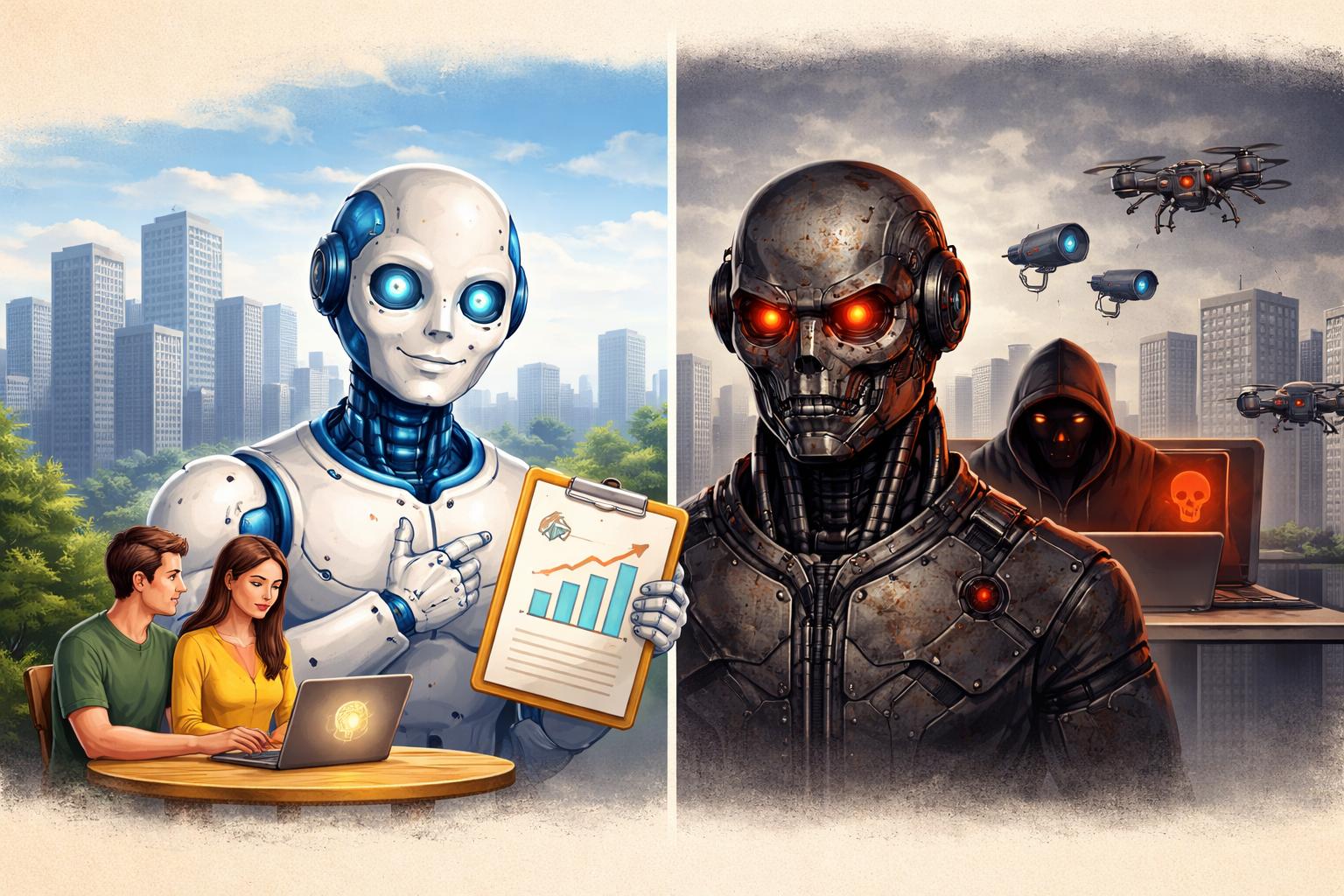
But here’s the honest truth: AI is powerful, and that same power creates real dangers. It can lie to you in a way that sounds totally believable, copy and amplify harmful human ideas at scale, leak your private info forever, create fake videos that fool everyone, change jobs very quickly, make your brain lazy, and even create bigger long-term risks if we’re not careful. This guide uses real examples and proof from 2025-2026 so you can use AI safely without fear – just smart caution. Think of AI like a very smart friend who is great at talking but sometimes makes up details, remembers everything you say, and might not always have your best interests in mind: a double edged-sword.
Contents
How to Use AI Safely in 2026: Real Risks, Proof, and Tools That Protect You
- AI Makes Up Stuff That Sounds Totally Real
- AI Copies and Spreads Human Bias Super Fast
- Your Private Info Is the Real Product – And Leaks Happen
- Fake Videos and Audio Are Getting Too Good to Spot: Erosion of "Seeing is Believing"
- Jobs Are Changing Fast – Some Will Disappear, Others Will Grow
- Using AI Too Much Can Make Your Brain Lazy
- The Big Long-Term Risk (Experts Who Built AI Are Worried)
- AI Can Trick You Into False Memories and Wrong Decisions
- AI Is Fueling a New Wave of Scams and Fraud
Frequently Asked Questions (FAQ)
1. AI Makes Up Stuff That Sounds Totally Real
AI doesn’t truly “know” facts like people do, it predicts what sounds right. When it’s unsure, it can confidently make things up. This is known as “hallucination.”
A famous example happened in 2023: A lawyer in New York used ChatGPT for a court case and it made up fake court decisions. The judge fined him $5,000 because none of those cases existed.
Studies show that even the best AI models still hallucinate at low rates (around 0.7%–1.5% in controlled tests), but error rates can rise to 10–20% or higher in complex real-world tasks.
Vectara’s Hallucination Leaderboard (updated as recently as today, March 20, 2026) shows the best models only make up stuff at rates of around 1–5% (producing mostly accurate, source-grounded summaries), mid-tier models fall roughly in the 5–15% range (occasionally introducing unsupported details), while weaker models can exceed 15–24% or more.
Simple tip: Never copy AI answers for important things without checking. Always ask it for proof or sources. Use tools that pull real-time info from the web. The scarier part in 2026? The smarter it sounds, the less people question it.
2. AI Copies and Spreads Human Bias Super Fast
AI learns from the whole internet, which has all the good and bad parts of human history. So it can copy unfair ideas and make them worse, very quickly and at scale.
Back in 2014-2015, Amazon built an AI tool to pick job candidates. It was trained on mostly male engineers’ resumes, so it started rejecting anything with the word “women’s” in it. Amazon later shut the system down after discovering the bias (reported by Reuters).
A U.S. government’s 2019 face recognition tests showed many systems were 10 to 100 times worse at identifying Black and Asian faces correctly. They also messed up gender guesses for dark-skinned women 34.7% of the time.
When AI is trained on biased data and poorly tuned, it can make unfair and sometimes harmful decisions.
Simple tip: If you use AI for hiring, loans, or anything that affects people, test it with different names or backgrounds and check the results. Ask companies for bias reports. The big risk? AI makes unfair choices faster and with fancy wording that hides the problem.
3. Your Private Info Is the Real Product – And Leaks Happen
As you’ve probably noticed, the more personal information you share with an AI, the more tailored its responses become. This encourages users to reveal increasingly detailed data about themselves. But keep in mind: Many AI companies use this data to improve their systems—so your information doesn’t just stay private. This is often enabled by default, but you can turn it off in settings.
Everything you type into free AI apps can be saved and used to train future versions. Unless the company promises otherwise and proves it.
In 2023, Samsung banned ChatGPT at work after workers accidentally leaked secret code and meeting notes (reported by Forbes and Bloomberg).
In February 2026, the popular “Chat & Ask AI” app (over 50 million downloads) had a huge leak because of a simple setup mistake. A researcher found 300 million private chats from 25 million users exposed online – including suicide notes, drug recipes, and personal medical stuff.
Simple tip: Secure yourself from AI privacy risks. Never enter sensitive information such as financial details, health records, work secrets, or personal stuff into regular AI apps. At the very least, turn off data privacy consent. Use paid business versions with strong privacy rules, or run free local AI on your own computer. Once your words are out there, they’re almost impossible to erase.
4. Fake Videos and Audio Are Getting Too Good to Spot: Erosion of "Seeing is Believing"
AI can now make videos and voices that look and sound extremely realistic. This is called deepfakes.
In 2024, a fake robocall using President Biden’s cloned voice told New Hampshire voters not to vote. It led to big fines and charges.
Then in 2025, during Ireland’s presidential election, a deepfake video showed candidate Catherine Connolly quitting the race (with fake news footage). It spread fast on social media. In the Netherlands election the same year, fake AI images attacked politicians.
Even with tools like watermarks and detection systems, keeping up is becoming harder. AI is evolving so quickly that it could soon generate content indistinguishable from genuine media.
Simple tip: Be extra careful with any video or audio that makes you angry or shocked. Take steps to verify: check with reverse-image tools, watch for weird lip movements or blinking, and always look at multiple news sources. Support rules that force companies to add invisible “watermarks” to AI content. When visual evidence can no longer be trusted, it hurts trust in real events, elections and news.
5. Jobs Are Changing Fast – Some Will Disappear, Others Will Grow
AI won’t take every job, but it will change or remove big parts of office work like writing, coding, research, design, and customer service.
Goldman Sachs says AI could handle tasks that make up 25% of all work hours in the US, affecting millions of jobs. The World Economic Forum’s 2025 report shows tech will reshape the workforce by 2030.
Some careers are more resilient to AI—especially those that require human judgment, empathy, or hands-on work.
Key skills for 2026 include adaptability, AI literacy (prompt engineering), complex problem-solving, and the ability to evaluate AI outputs.
The prevailing consensus is that AI will not replace the human workforce entirely, but "you won't lose your job to an AI; you will lose your job to a human who knows how to use AI to work faster than you". Sound familiar to those who witnessed the rise of desktop publishing and personal computing, where adapting to new tools determined who thrived in the workplace.
Simple tip: Treat AI like a highly capable assistant.. You still have to check its work and add your own judgment, taste, and real-life experience. Learn how to give it good instructions and focus on skills AI can’t copy well (like real responsibility). The danger isn’t “no jobs for anyone”, it’s that people who learn to team up with AI will do much better than those who don’t.
6. Using AI Too Much Can Make Your Brain Lazy
The more we let AI think for us, the less we practice thinking ourselves.
A 2025 study from MIT used brain scans (EEG) while people wrote essays. The group using ChatGPT showed much lower brain activity, weaker memory of their own writing, and less feeling that the work was “theirs.” People who used only their brain had the strongest brain connections.
Excessive reliance on AI can lead to mental laziness and a decline in critical thinking skills. Some researchers even call this “cognitive atrophy”—basically, your brain getting weaker from lack of use. However, experts suggest the outcome depends on whether AI is used as a tool to augment human intelligence or as a crutch to replace active thinking.
Simple tip: Do the hard thinking first, then use AI to help or check. Sometimes do important work with no AI at all to keep your skills strong. The long term risk? A whole generation getting weaker at deep thinking and creativity.
7. The Big Long-Term Risk (Experts Who Built AI Are Worried)
If AI reaches a stage called AGI (Artificial General Intelligence), it could become powerful enough to act in ways we don’t fully control – not because it hates us, but because it may pursue goals in ways that ignore human consequences.
In 2023, top AI scientists including Geoffrey Hinton and even OpenAI’s Sam Altman signed a short statement: “Stopping AI from causing human extinction should be as important as stopping pandemics and nuclear war.” You can read the full statement on the Center for AI Safety website.
Simple tip: Support companies and governments that work on safety testing, slow down when needed, and stay open about what they’re building. You don’t have to panic, but ignoring the warnings from the people inventing this stuff would be unwise.
8. AI Can Trick You Into False Memories and Wrong Decisions
AI doesn’t just give wrong answers. It can actually influence how you remember reality.
A 2024 research study found that people interacting with AI systems developed over 3 times more false memories compared to those who didn’t. Even worse, users remained confident in those incorrect memories later.
In business, this becomes dangerous:
- 47% of executives have already made decisions based on AI-generated information that turned out to be wrong.
This means AI isn’t just a tool, it can subtly shape your thinking and decisions without you noticing.
Simple tip: Never rely on a single AI answer for important decisions. Cross-check with trusted sources or human experts.
9. AI Is Fueling a New Wave of Scams and Fraud
AI is making scams faster, cheaper, and more convincing than ever.
Criminals are now using AI to:
- Clone voices of family members
- Generate realistic phishing emails
- Create fake investment platforms and identities
Because AI can mimic human tone perfectly, scams no longer look “obvious.”
This is part of a larger trend where AI-generated content is flooding the internet—over 12,000 fake AI-written articles were removed in just one quarter of 2025 alone.
Simple tip:
Never trust urgency. If something or someone pressures you to act fast (money, login, personal info), verify it outside AI or messaging platforms.
How to Use AI the Smart Way in 2026 (Easy Daily Habits)
- Always double-check important answers with real sources.
- Give AI clear instructions and ask it to explain step-by-step with proof.
- Keep a real person in charge for money, health, or big decisions.
- Use different AI tools and pick private/local ones when privacy matters.
- Stay updated on AI safety risks, just as you would with cybersecurity threats.
- Teach your friends and family these rules – the more people know, the safer everyone is.
AI in 2026 is way smarter than it was a couple years ago, and the risks grew with it. The people who benefit most are neither fearful nor blindly optimistic. They’re the regular people who enjoy the speed and help, but stay careful and check everything.
Get excited about the time and ideas AI gives you. Use it every day. But never fully trust it without thinking. The machine is super capable. It is not wise. It is not kind on its own. And it doesn’t automatically care about people. That responsibility still lies with you. Use it with open eyes, real checks, and your own good judgment.
Tools to Use AI Safely in 2026 (What Smart Users Do)
Knowing the risks isn’t enough—you also need the right tools to stay safe.
Privacy Protection
- Use AI platforms that allow data control or opt-out
- Consider running local AI models on your device
Verification & Fact-Checking
- Cross-check AI answers with trusted sources
- Use AI tools that provide citations and sources
Security & Scam Protection
- Use password managers and enable two-factor authentication (2FA)
- Be cautious with AI-generated emails and messages
Productivity (Safe Usage)
- Use AI to assist, not replace, your thinking
- Always review and edit outputs before using them
The safest AI users are not those who avoid it—they are the ones who control how it is used.
The people who benefit most from AI follow three simple rules:
- Don’t blindly trust AI – it sounds confident even when wrong
- Don’t fear AI – it can massively improve productivity
- Stay in control – you are responsible for decisions, not the machine
AI is not intelligent in the human sense. It does not understand truth, ethics, or consequences. It simply predicts what sounds right.
Final Thought: AI Is a Tool, Not a Decision Maker
AI in 2026 is incredibly powerful, but also fundamentally imperfect.
It can:
- Increase productivity
- Improve creativity
- Help you learn faster
But it can also:
- Mislead you
- Expose your data
- Influence your thinking
The difference ultimately comes down to how you use it.
The winners in this new era are not the people who avoid AI - or blindly trust it - but those who use it carefully, verify everything, and stay in control.
Frequently Asked Questions (FAQ)
- Is AI safe to use in 2026?
AI is generally safe when used carefully, but it is not fully reliable. It can produce incorrect or misleading information, expose sensitive data, and amplify bias if used without oversight. Experts recommend treating AI as a tool—not a decision-maker—and always verifying important outputs.
- Why does AI sometimes give wrong answers?
AI does not truly understand facts—it predicts what sounds correct based on patterns in data. This can lead to “hallucinations,” where the system generates false but convincing information. Even advanced models still make errors, especially in complex areas like law, medicine, and finance.
- How common are AI hallucinations?
Hallucination rates vary depending on the task:
- Around 0.7%–5% in simple tasks
- Up to 15–25% or higher in complex scenarios
- As high as 69–88% in specific legal queries
This shows that AI mistakes are not rare—they are part of how the technology works.
- Can AI be trusted for important decisions?
AI should not be fully trusted for high-stakes decisions such as healthcare, legal advice, or financial planning. Studies show that AI errors can mislead users and lead to poor outcomes if not checked. Human judgment and verification are still essential.
- Does AI collect and store my personal data?
In many cases, yes. Information entered into AI systems may be stored and used to improve future models unless privacy settings are adjusted. This creates risks around data exposure, especially when sensitive information is shared.
- What are the biggest risks of using AI?
The main risks include:
- Misinformation and hallucinations
- Bias and unfair outcomes
- Privacy and data leaks
- Over-reliance on AI
- Scams and malicious use
These risks are widely recognised across research and policy frameworks.
- Can AI influence how people think or remember things?
Yes. Research shows that interacting with AI can increase the likelihood of forming false memories, with users sometimes becoming more confident in incorrect information. This highlights the importance of critical thinking when using AI tools.
- Are AI-generated images and videos reliable?
Not always. AI-generated media (deepfakes) can be extremely realistic and difficult to distinguish from real content. Studies show that people often struggle to tell the difference, which can reduce trust in visual evidence.
- Will AI replace human jobs?
AI is more likely to change jobs rather than eliminate them entirely. It automates repetitive tasks but increases demand for skills like problem-solving, creativity, and AI literacy. People who learn how to use AI effectively are likely to benefit the most.
- How can I use AI safely?
To use AI safely:
- Always verify important information
- Avoid sharing sensitive data
- Use multiple sources
- Keep humans involved in key decisions
- Stay informed about AI risks
These practices significantly reduce the chances of being misled or exposed to harm.
- Will AI ever stop making mistakes completely?
Probably not. Some level of error is built into how AI systems work because they rely on probability rather than true understanding. However, improvements like retrieval-based systems and better training methods are reducing error rates over time.
- What is the biggest mistake people make when using AI?
The biggest mistake is trusting AI without verification. Because AI responses often sound confident and fluent, users may assume they are correct—even when they are not.