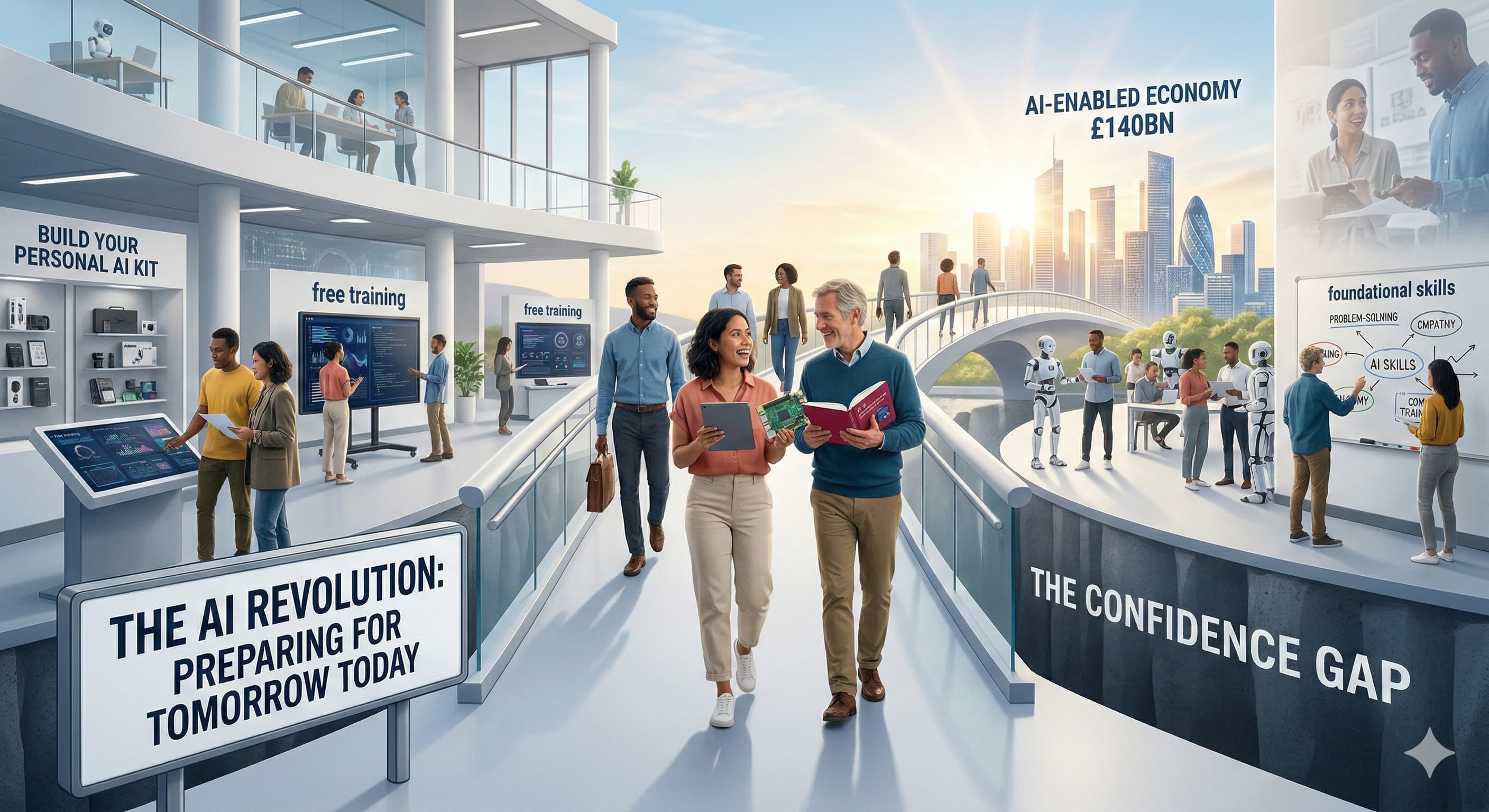
Artificial Intelligence (AI) is rapidly changing how people work, learn, and run businesses. In just a few years, AI has moved from being a specialised technology used mainly by researchers to a tool that millions of people now use every day.
By 2026, AI will likely become a normal part of everyday work. Businesses, schools, governments, and individuals are all beginning to rely on AI to improve productivity, make decisions faster, and solve complex problems.
But many people still ask important questions:
- Will AI take jobs?
- How can small businesses benefit from AI?
- What skills will people need to succeed?
- What tools should people start using now?
Understanding these questions is important because the people who learn to work with AI early will have a major advantage in the future.
What Artificial Intelligence Actually Is
Artificial Intelligence refers to computer systems that can perform tasks that normally require human intelligence.
These tasks include:
- writing text
- analysing large amounts of data
- recognising images
- translating languages
- creating videos and images
- answering questions
Modern AI systems use advanced algorithms and large datasets to learn patterns and generate useful results.
One of the biggest breakthroughs in recent years has been generative AI, which can create new content such as articles, designs, computer code, and music.
These systems are becoming powerful productivity tools across many industries.
However, experts emphasise that the real value of AI comes from augmenting human ability rather than replacing humans entirely. In practical terms, this means that the future workplace will likely involve humans and AI working together.
How AI Is Changing the Job Market
Many people worry that AI will eliminate large numbers of jobs. While some roles will decline, most experts believe the overall impact will be more complex.
Research shows that about one in four jobs contains tasks that AI could influence, but only a small percentage of jobs are expected to disappear completely.
Instead, most jobs will change.
Why Some Jobs Will Decline
Jobs that involve routine and predictable tasks are easier for AI systems to automate.
These jobs often follow clear rules and processes that software can learn.
Examples include:
- data entry
- basic bookkeeping
- simple customer support
- document processing
- scheduling tasks
AI systems can complete these tasks quickly and accurately because they process information much faster than humans.
For example, an AI program can analyse thousands of financial transactions in seconds, while a human worker might take several hours.
As companies adopt these technologies, they may need fewer workers to perform routine tasks.
Why Many Jobs Will Grow
While some roles decline, many others will grow because AI increases productivity.
Jobs that require human judgement, creativity, empathy, or complex decision-making are difficult to automate.
Examples include:
- Healthcare professionals
- Teachers and educators
- Engineers and scientists
- Creative professionals
- Business strategists
In these roles, AI acts as a tool that helps professionals work faster and more effectively.
For example:
Doctors may use AI to analyse medical images quickly, but human expertise is still needed to interpret results and decide treatment plans.
Teachers may use AI learning tools to track student progress, but human teachers still provide guidance, motivation, and mentorship.
New Careers Created by AI
Technological change has always created new types of work, and AI is no exception.
New roles are emerging such as:
- AI trainers who teach AI models how to respond correctly
- data curators who organise training data
- AI ethics specialists who ensure systems operate fairly and responsibly
These roles demonstrate that AI is not just replacing work—it is also creating new opportunities.
Why AI Skills Are Becoming Essential
Because AI is spreading across industries, employers increasingly expect workers to understand how to use AI tools.
Research shows demand for AI-related skills increased about seven times in only two years.
However, learning AI does not necessarily require advanced programming skills.
Many modern AI tools are designed for everyday users.
People can now use AI to:
- write articles and reports
- generate marketing content
- analyse data
- automate repetitive tasks
- manage business workflows
Learning how to use these tools effectively is becoming a valuable skill across many professions.
How AI Is Creating Opportunities for Small Businesses
AI may have its greatest impact on small businesses and entrepreneurs.
In the past, starting and running a business often required large teams of specialists.
A company might need:
- marketing experts
- graphic designers
- customer service teams
- data analysts
- software developers
Hiring these professionals could be expensive for small businesses.
AI tools now allow individuals and small teams to perform many of these tasks themselves.
AI in Marketing
AI tools can generate blog posts, social media content, advertising copy, and email campaigns.
This allows entrepreneurs to market their products without hiring full marketing teams.
AI in Customer Support
AI chatbots can answer common customer questions instantly.
This means businesses can provide 24-hour customer service without hiring large support teams.
AI in Product Research
AI systems can analyse customer data and market trends.
This helps entrepreneurs identify opportunities and design products that people actually want.
Because of these advantages, AI is lowering the barriers to starting a business.
A single individual can now operate a business that previously required an entire team.
Recommended AI Tools for Small Businesses
These tools are commonly used by entrepreneurs and freelancers.
| Tool | Best For | Why It Helps |
|---|---|---|
| Jasper AI | Content creation | Generates marketing copy and blog posts |
| Surfer SEO | SEO optimisation | Helps articles rank on Google |
| Copy.ai | Marketing automation | Creates social media and ad copy |
| Pictory | Video creation | Converts articles into videos |
| Canva AI | Graphic design | Creates visuals quickly |
Many entrepreneurs combine 3–5 AI tools to automate most of their content and marketing workflow.
How AI Will Change Education
Education systems are also adapting to AI technologies.
Traditional classrooms often teach large groups of students at the same pace.
AI can personalise education.
Personalised Learning
AI systems can track how students learn and adjust lessons accordingly.
If a student struggles with a topic, the system provides extra practice.
If a student learns quickly, it introduces more advanced material.
This approach can improve learning outcomes.
AI Tutors
AI-powered tutors allow students to ask questions anytime.
Instead of waiting for help from a teacher, students can receive instant explanations and guidance.
This could help millions of students around the world access better education.
Changing Skills for the Future
As AI becomes common, schools are focusing more on skills that machines cannot easily replace.
These include:
- critical thinking
- creativity
- collaboration
- problem solving
These human skills will become increasingly valuable in the AI economy.
The Risks and Challenges of AI
While AI offers many benefits, it also creates new challenges.
Experts emphasise the importance of managing these risks carefully.
Bias in AI Systems
AI systems learn from existing data.
If the data contains bias, the AI system may produce unfair results.
For example, an AI hiring tool could favour certain applicants if the training data reflects past hiring patterns.
This is why responsible design and oversight are important.
Data Privacy Concerns
AI systems often rely on large amounts of personal data.
If this data is not protected properly, it could be misused or exposed.
Strong privacy protections are essential.
Economic Inequality
Some experts worry that AI could increase inequality between countries and workers.
Regions with strong technology industries may benefit more from AI than those without advanced digital infrastructure.
Addressing these challenges requires thoughtful policies and international cooperation.
Devices That Work Best With AI Tools
AI software runs best on modern devices.
Recommended devices include:
- high-performance laptops
- tablets for mobile productivity
- smartphones with AI assistants
- cloud computing platforms
Powerful processors and strong internet connections allow AI tools to run smoothly.
Many professionals now choose devices designed specifically for AI productivity workflows.
High-Converting AI Tools Comparison
Below are popular AI tools many professionals use today.
| Tool | Best Use | Key Benefit |
|---|---|---|
| Jasper AI | Writing | Produces high-quality marketing content |
| Surfer SEO | SEO | Optimises articles for search engines |
| Notion AI | Productivity | Organises tasks and documents |
| Synthesia | Video | Creates AI videos without cameras |
| Canva AI | Design | Generates graphics and presentations |
These tools help individuals save time and increase productivity dramatically.
Why Early AI Users Gain the Biggest Advantage
Historically, people who adopt new technologies early often gain the most opportunities.
For example:
People who learned the internet early built successful online businesses.
People who learned social media marketing early built large audiences.
The same pattern is happening with AI.
Early adopters are already using AI to:
- automate work
- create content faster
- build online businesses
- analyse data more effectively
Those who learn these tools today may gain a major advantage in the coming years.
Key Takeaway: AI Is a Tool, Not a Replacement
The most important thing to understand about AI is that it is a tool.
Like any tool, its impact depends on how people use it.
AI can:
- increase productivity
- create new industries
- expand economic opportunity
- help solve global challenges
But its benefits will be greatest for people who learn how to use it effectively.
The future will belong not to people who fear AI, but to those who learn to work alongside it.