
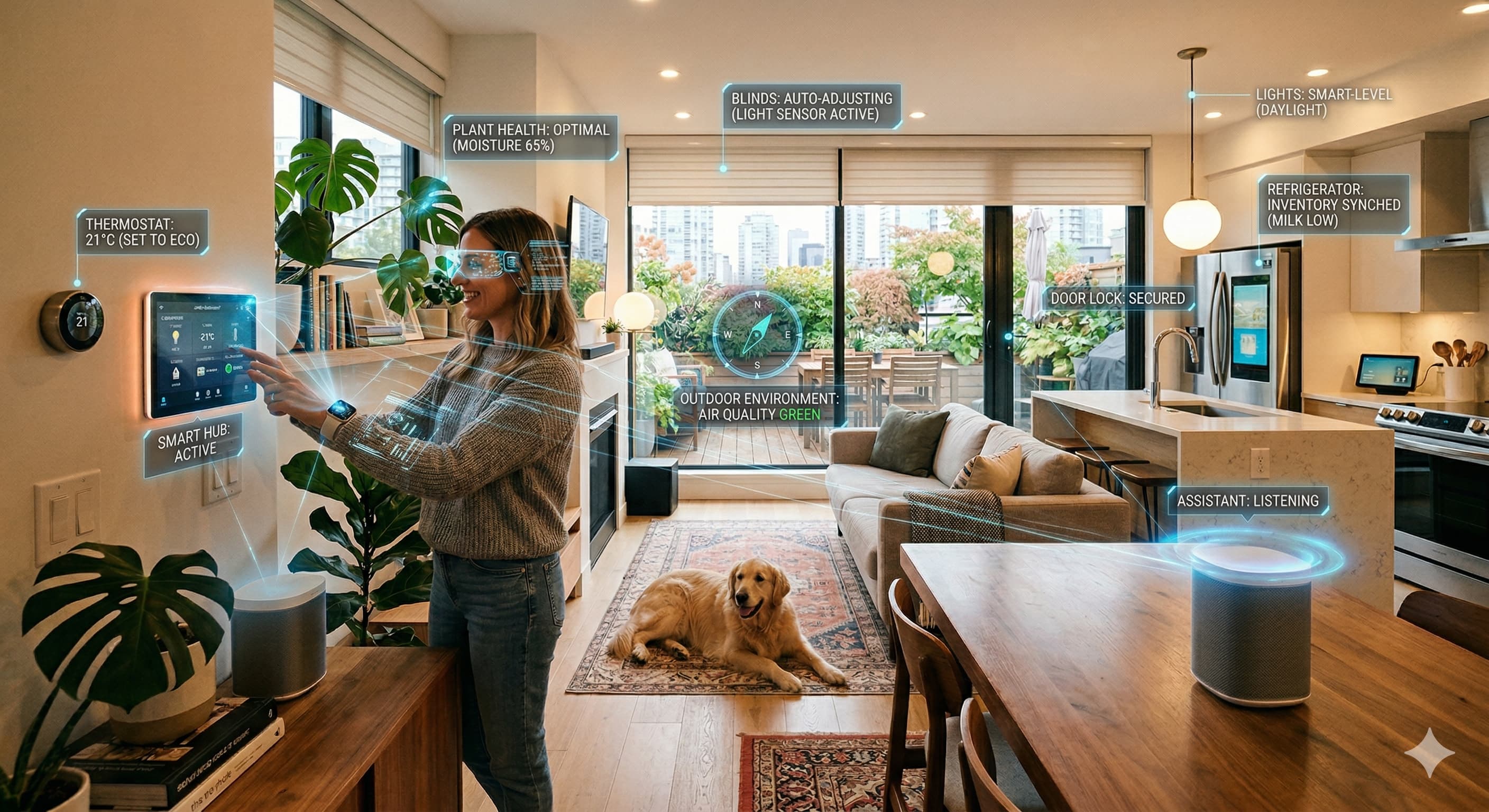
Smart homes are no longer just about voice assistants, flashy gadgets, or turning lights on with your phone. For many families, the real questions are much more practical: do smart homes save money, improve comfort, support health, increase security, and make daily life easier without creating new problems? That is what matters most.
This guide looks at smart homes from a family point of view. It explains what smart homes are, how they evolved, the features that add the most value, whether they can reduce energy bills, how they affect wellness and activity levels, and what to think about before building a smart home from scratch or adding smart features to an existing house. If you are wondering whether a smart home is worth it, where to start, or what mistakes to avoid, this article will help you make a more confident decision.
Content
Definitions and types of smart homes
Core components and connectivity
Smart-home features that add real value
The "Responsive Sanctuary": Health Benefits and Health Risks of Smart Homes
- Advanced Indoor Environmental Quality (IEQ)
- Circadian Lighting and Sleep Hygiene
- Mental Health and Cognitive Support
- Safety as Emotional Wellness
Smart Home Retrofit vs New Build
Retrofit vs new-build comparison table
Do smart homes really save money?
Are smart homes good for health and wellness?
Can smart homes make people lazy or less active?
What are the most useful smart home features for families?
Is it better to build a smart home from scratch or add features later?
What should I buy first for a smart home?
Smart homes have evolved from early “remote control over power lines” (X10, developed in 1975) into modern, app- and automation-driven ecosystems built around IP networking, interoperability standards like Matter, and a growing push for local control and smarter energy management.
For families, the best smart-home results usually come from targeting outcomes—comfort, risk reduction, energy waste reduction, and accessibility—rather than buying a pile of gadgets and hoping the savings appear.
Done well, smart homes can reduce heating/cooling costs, improve indoor air quality practices, support safer routines and enhance security; done poorly, they can add always-on energy use, increase privacy/cyber risk, and create dependence on cloud services and fragile Wi-Fi.
The “rise” is now shifting from convenience-first smart homes to energy-aware, security-conscious homes that can participate in demand flexibility and coordinate solar, batteries, and EV charging through Home Energy Management Systems (HEMS).
Highlights
- Focus on the "Why": The most successful smart homes are designed to achieve tangible goals like reducing energy waste, improving family safety, and increasing comfort, rather than just collecting a pile of gadgets.
- Matter is a Game-Changer: The new interoperability standard, Matter, is crucial because it allows devices from major companies like Apple, Google, and Amazon to work together seamlessly, simplifying choices for homeowners.
- The Big Picture is Energy Management: The true evolution of the smart home is the shift to a Home Energy Management System (HEMS). This involves coordinating solar panels, home batteries, and EV charging to reduce costs and create a more grid-friendly home.
- Get the Best Return on Investment: Smart thermostats offer the clearest financial payback by saving on heating and cooling, which are the largest energy expenses in most homes. Leak detectors and smoke/CO alerts offer a high "return on safety" by preventing costly disasters.
- Plan for Health and Wellness: Smart home technology can directly support a healthier lifestyle by automating air filtration, improving ventilation, and creating lighting scenes that protect natural sleep cycles.
- Security is Non-Negotiable: Because smart homes collect intimate data about your daily life, prioritizing strong cybersecurity practices, secure passwords, and devices from reputable manufacturers is essential.
Smart homes then and now
The earliest widely adopted home-automation era is commonly associated with X10, a protocol that used existing electrical wiring (powerline signaling) to send control commands—an idea that made “smart features” possible without ripping open walls.
What changed over the following decades wasn’t only device capability; it was connectivity and usability: widespread broadband, smartphones, cheap sensors, and cloud services turned “automation” into mass-market consumer “smart home devices.”
If you have ever avoided smart home gadgets because they seemed confusing, Matter is the development worth paying attention to. It is a modern smart home standard built to improve compatibility between devices and platforms, so buyers can spend less time worrying about ecosystems and more time choosing products that actually fit their home and lifestyle.
Matter is backed by many of the biggest names in smart home technology, which is a large part of why it matters so much to buyers. The standard was originally developed with support from Amazon, Apple, Comcast, Google, Samsung SmartThings, and the Connectivity Standards Alliance, alongside other major industry players such as IKEA, Legrand, NXP Semiconductors, Resideo, Schneider Electric, Signify, Silicon Labs, Somfy, and Wulian. In practical terms, that means Matter is being built around the ecosystems ordinary consumers already know, including Amazon Alexa, Apple Home, Google Home, and Samsung SmartThings, rather than as a niche standard that only works in one corner of the market.
Today’s smart-home shift is strongly shaped by interoperability and resilience. Matter is described as an open-source, royalty-free standard aiming to unify smart-home devices across ecosystems and simplify development/compatibility.
The Connectivity Standards Alliance, a global member-driven organization that creates and maintains the Matter standard continues to expand Matter’s scope; for example, Matter 1.5 (released Nov 20, 2025) added support for cameras, “closures” (like blinds/garage doors), and enhanced energy-management capabilities—signals that modern smart homes are moving beyond lights and thermostats into deeper, utility-relevant functions. CSA announcement
Local control has also become a major theme because families want faster response, less downtime during internet outages, and better privacy boundaries. Offline smart homes are possible with compatible devices and protocols, but many off-the-shelf products assume internet connectivity by default—so planning matters if you want “smart” without “always cloud.”
Finally, AI is becoming more visible in consumer messaging and real-world features (prediction, pattern learning, anomaly alerts), with industry guidance framing AI as “automating the automation” by learning and adapting beyond fixed rules—useful, but not a substitute for good design and safeguards.
CEDIA is a trusted industry organisation for smart homes that helps homeowners understand smart home technology and connect with qualified professionals who can design and install it properly. It presents itself as a resource for homeowners as well as the wider smart home industry, and its guidance focuses on making homes more convenient, efficient, comfortable, and secure through well-planned technology.
Definitions and types of smart homes
A practical definition is: a smart home is a residence that uses connected technologies to monitor and control home functions (like climate, lighting, and security) to improve comfort, efficiency, and convenience, typically through automation software and remote access.
Most real-world smart homes fall into four overlapping “types,” which is useful for families because each type implies different priorities, costs, and risks.
Core components and connectivity
Smart homes work as systems with five core building blocks: sensors, actuators, a controller/hub, connectivity, and interfaces. CEDIA describes smart homes as integrated setups where devices like thermostats, lighting, cameras, locks, and speakers work together via connectivity and automation software.
A useful way to explain the pieces is “sense → decide → act.”
Sensors detect motion/doors/temperature/humidity/leaks; actuators change something (switch lights, adjust HVAC setpoints, lock a door); the controller coordinates logic and automations; connectivity moves data and commands; and interfaces are how people interact (apps, voice, keypads, wall switches, dashboards).
Connectivity choices are now a primary design decision because they determine reliability, latency, and future device compatibility. Matter is positioned by its standards body as an IP-based unifying protocol designed for reliable and secure ecosystems.
Local control is the resilience layer: a home that can run core automations and safety actions locally is more likely to keep functioning during internet outages and less likely to “break” due to cloud changes.
Smart-home features that add real value
Smart-home features create value when they reduce waste, reduce risk, or improve health outcomes—not merely when they add novelty. Evidence on domestic heating controls caution that many energy-saving claims are overstated or based on low-quality evidence, and that real savings depend heavily on context (building efficiency, climate, user behavior, how controls are configured). This is why “feature-by-feature” thinking beats “buy everything” thinking.
Climate control
Climate control features are usually the top ROI drivers because heating and cooling are major loads and are sensitive to scheduling, occupancy, and setpoints. ENERGY STAR reports that certified smart thermostats save about 8% of heating and cooling bills on average (about $50/year), while noting savings vary with climate, comfort preferences, occupancy, and HVAC equipment.
Energy visibility
Energy visibility features matter because feedback changes behavior; a UK government study suggests that smart meters reduce electricity consumption by about 3.43% and gas by about 2.97% on average, though real-world results vary by engagement and households.
Safety & damage prevention
Safety and damage prevention features often “pay back” by avoiding rare but expensive events rather than by shaving a few dollars per month. Leak detection sensors and shutoff strategies can substantially reduce damage severity, even when they don’t guarantee premium reductions.
HEMS & energy flexibility
Energy-focused smart homes and HEMS features are rising in value as homes add solar PV, batteries, heat pumps, and EV chargers.
Top features of smart homes:
- Smart thermostat or smart HVAC control with scheduling/occupancy logic.
- Whole-home or circuit/device-level energy monitoring (or smart meter + strong in-home display/app use).
- Water-leak sensors (and shutoff where feasible) plus smoke/CO alerts.
- Lighting control focused on scheduling, safety, and sleep-friendly evening modes.
- A hub/controller strategy that prioritizes interoperability and local control for core automations.
Do smart homes save money
Smart homes can save money, but it’s more accurate to say they reduce waste—if you implement the right features and stick the landing on setup.
Smart meters and feedback can also reduce consumption, but the savings are usually modest percentages and depend on engagement; the UK government review’s meta-analysis estimates ~3.43% electricity and ~2.97% gas reductions on average.
A hidden cost-competitor to “smart savings” is always-on energy use (standby draw). Natural Resources Defense Council testing estimated that ~50 million smart speakers in the U.S. consumed about 783 GWh/year, costing consumers around $100 million annually—showing why “smart everything” can raise baseline electricity use if you don’t watch it.
The ROI reality is therefore feature-specific: some devices cut a large load (HVAC), some shift behavior (feedback), and some mainly add convenience while increasing standby energy (which might still be worth it, but isn’t “savings tech”).
Sustainable smart homes
On sustainability, smart homes matter most when they enable demand flexibility—the ability to shift or adjust electricity use in response to grid conditions. A Demand Flexibility Analysis by International Energy Agency explains that demand flexibility improves utilization of existing generation and networks, reduces peak stress, lowers losses/curtailment, and supports more efficient integration of clean energy.
This is where HEMS becomes the “grown-up” version of smart homes: coordinating EV charging, solar self-consumption, batteries, and flexible loads so the household saves money while becoming more grid-friendly, as described in the IEA 4E global market scan.
The "Responsive Sanctuary": Health Benefits and Health Risks of Smart Homes
Smart homes can support wellness when they improve the indoor environment and reinforce healthy routines. U.S. Environmental Protection Agency emphasizes that a key way to improve indoor air quality is source control (reduce or eliminate pollution sources), and also discusses ventilation and filtration—exactly the categories smart homes can support through monitoring, reminders, and automation.
Sleep is another area where smart homes can help or harm: a study found that exposure to room light before bedtime suppressed melatonin and delayed melatonin onset in most participants, shortening melatonin duration by about 90 minutes—evidence that “bright lights late” is a real physiological disruptor.
The “lazy home” concern is less about smart tech’s existence and more about design choices that remove everyday movement and push more time into screen time. World Health Organization guidelines recommend not only physical activity but also reducing sedentary behaviors across age groups, which is a useful lens for designing automations that encourage breaks rather than enabling all-day sitting.
A smart home can support activity if it nudges movement (scheduled walk reminders, “stand and stretch” prompts, automations tied to routines) and avoids over-optimizing convenience (voice-everything) in ways that erode daily steps.
Modern smart home research has moved beyond simple automation toward Ambient Intelligence (AmI)—environments that intuitively adapt to a resident's biological needs. According to recent research, the focus of the smart home industry has shifted from a "technology-push" (selling gadgets) to a "user-centric" model that prioritizes quality of life and healthcare.
1. Advanced Indoor Environmental Quality (IEQ)
Recent studies now treat the home as a "critical determinant of human health". Smart systems are being leveraged to manage four interconnected pillars of wellness:
- Air and Water Purity: Beyond simple sensors, 2026 trends include "Invisible Orchestration," where AI-driven systems monitor Volatile Organic Compounds (VOCs) and CO2 levels in real-time. Research suggests optimal sleep and cognitive function occur at levels around 380 ppm CO2, which smart ventilation can maintain automatically.
- Thermal and Acoustic Comfort: New bio-inspired optimization algorithms can now reduce energy consumption while keeping noise levels below 30 dB, a critical threshold for restorative sleep.
2. Circadian Lighting and Sleep Hygiene
The World Health Organization (WHO) and other health bodies have long warned about "melatonin suppression" caused by artificial blue light.
- Biological Alignment: Leading health-tech experts highlight "Circadian Technology" (e.g., systems like Ketra) that mimics natural sunlight patterns. These systems support the body’s natural rhythm, improving sleep quality and mental clarity.
- HypnOS and CaLmi Systems: Recent research has developed specific frameworks like HypnOS, which integrates wearable data (heart rate, sleep stages) with home sensors to dynamically adjust a room’s temperature to roughly 21°C for optimal rest.
3. Mental Health and Cognitive Support
The CDC and Frontiers in Digital Health (2025) emphasize that smart homes are now vital for "Aging in Place" and mental health interventions:
- Behavioral Monitoring: AI-enabled systems can analyze movement patterns to detect early signs of depression or cognitive decline—such as reduced social interaction or disrupted eating habits—enabling proactive care before a crisis occurs.
- Stress Reduction through Audio: Smart audio systems are being leveraged for "pervasive relaxation programs," using automated playlists of white noise or meditation tracks to lower cortisol levels during high-stress periods.
4. Safety as Emotional Wellness
Reputable organizations like the Housing Learning and Improvement Network (LIN) note that "emotional safety" is a core component of wellness. In 2026, predictive analytics are being used to identify residents at a high risk of falls or social isolation, significantly reducing anxiety for both the resident and their family members.
CyberSecurity Reality
Cybersecurity and privacy are the non-negotiables because smart homes handle intimate data about daily life. ETSI EN 303 645 is a widely cited baseline standard for consumer IoT security, including principles like “no universal default passwords,” vulnerability disclosure processes, and software update expectations.
Regulators are also raising the floor: the UK’s consumer connectable product security regime provides guidance connected to the Product Security and Telecommunications Infrastructure Act and related regulations, reinforcing baseline expectations around passwords and transparency on security updates.
To minimize cybersecurity risks, the ETSI (European Telecommunications Standards Institute) group created a standard in 2021, the ETSI EN 303 645 which provides a global baseline for the security of connected consumer IoT devices.
13 Core Provisions Checklist ETSI EN 303 645 Guide
- No Universal Default Passwords: Mandatory requirement for unique passwords per device or user-defined authentication.
- Implement a Means to Manage Reports of Vulnerabilities: A vulnerability disclosure policy (VDP) must be in place, allowing security researchers to report issues.
- Keep Software Updated: Devices must be securely updatable, with updates applied easily.
- Securely Store Sensitive Security Parameters: Cryptographic keys and credentials must be stored securely, preferably via hardware-backed security.
- Communicate Securely: Data transmitted over networks should be encrypted, particularly when using public networks.
- Minimize Exposed Attack Surfaces: Disable unused security-sensitive interfaces (like debug ports) and network services.
- Ensure Software Integrity: Use mechanisms such as code signing to verify that software has not been tampered with.
- Ensure that Personal Data is Secure: Protect user data stored or transmitted by the device.
- Make Systems Resilient to Outages: Devices should remain functional or fail securely in the event of network or power outages.
- Examine System Telemetry Data: Monitor system activity to identify potential security anomalies.
- Make it Easy for Users to Delete Personal Data: Provide a straightforward way for users to remove their personal data.
- Make Installation and Maintenance of Devices Easy: Guidance and secure default configurations must be provided to users.
- Validate Input Data: Sanitize and validate all data inputs to prevent vulnerabilities like SQL injection or buffer overflows.
Smart Home Retrofit vs New Build
The biggest difference between a purpose-built smart home and a retrofit is infrastructure and long-term reliability, not whether automation is possible. In a new build, you can plan structured cabling, power placement, network topology, and equipment space while walls are open; industry guidance frames structured cabling as the “backbone” supporting multi-gigabit networking and PoE, while wireless remains the convenience layer.
In retrofits, success depends more on ecosystem discipline (interoperability choices, local control strategy, avoiding Wi-Fi congestion) and thoughtful rollout phases, because you’re often working with existing electrical layouts and inconsistent coverage.
Maintenance is the part that is often ignored, but it’s where many “my smart home is annoying” stories begin. CEDIA explicitly argues that aftercare plans and ongoing maintenance matter because smart homes evolve, devices require updates, and security risks change; even DIY households benefit from thinking in “lifecycle terms” (support windows, firmware updates, battery replacement, and deprecations).
Local control can reduce fragility by letting core functions keep running without internet, but you still need a plan for updates, backups, and failures—because “offline-capable” is not the same as “maintenance-free.”
Retrofit vs new-build comparison table
|
Topic |
New-build smart home |
Retrofit smart home |
|
Networking foundation |
Easier to design structured cabling, PoE runs, equipment closet, and access-point placement early. |
More dependent on Wi-Fi coverage, mesh tuning, and device placement workarounds; may still add Ethernet in selective areas. |
|
Controller strategy |
Can standardize a hub/controller architecture from day one (local control, clean integrations). |
Often starts as “device-by-device” then consolidates; fragmentation risk is higher unless you plan for interoperability (e.g., Matter where relevant). |
|
Hidden costs |
Higher upfront planning cost, but fewer “patchwork” fixes later; cleaner install aesthetics. |
Lower upfront cost if phased, but higher risk of replacing incompatible gear, adding repeaters, or redoing automations. |
|
Best first wins |
Build in high-ROI sensors and wiring for future energy/care upgrades (leaks, HVAC zoning, network). |
Start with HVAC control + leak/smoke alerts + energy visibility; expand once reliability is proven. |
Top features by budget table
|
Budget tier |
Best “first buys” |
Why they’re high value |
|
Starter |
Smart thermostat; leak sensor under sink; a few smart plugs for true “auto-off” loads |
HVAC savings are among the best-supported consumer smart-home ROI claims. Leak detection prevents costly damage. Smart plugs can reduce standby waste if used intentionally. |
|
Mid-range |
Energy monitor / smart-meter engagement; smart lighting schedules; hub/controller for consistent automations |
Feedback can reduce consumption modestly, and lighting schedules can support safety + sleep routines if designed well. A controller reduces ecosystem chaos. |
|
Advanced |
HEMS for solar/battery/EV coordination; structured networking upgrades; local-control-first architecture |
This tier unlocks sustainability and demand flexibility value by coordinating major loads and DERs, improving grid friendliness and potential savings depending on tariffs and usage. |
Family decision checklist
- Define the outcome first (comfort, safety, energy savings, care/accessibility) and buy features that directly serve it. CEDIA smart home basics
- Prioritize HVAC control and energy visibility before convenience-only devices if ROI matters to you.
- Treat leak/smoke/CO alerts as “home resilience,” not “smart gadgets,” and plan how alerts escalate (who gets notified, what happens next).
- Design lighting to protect sleep (dim/warm evenings, limited late-night brightness) because room light before bedtime can suppress melatonin and shift timing.
- Make “move more, sit less” a design principle: use reminders and routines that encourage breaks rather than eliminating every step through voice control.
- Choose products aligned with baseline security expectations (no default passwords, clear update support, vulnerability handling) and follow regulatory guidance where applicable. ETSI EN 303 645
- Plan for lifecycle: firmware updates, batteries, device support windows, and the possibility that cloud services change; consider maintenance/aftercare planning even for DIY setups. CEDIA aftercare
- Track standby power and “always-on” features, because smart devices can increase baseline electricity use at scale. NRDC standby findings
Smart Home FAQ
What is a smart home?
A smart home is a home where connected devices such as lighting, heating controls, locks, sensors, cameras, plugs, and appliances can be monitored, automated, or controlled remotely or through routines.
Do smart homes really save money?
They can, but only when they reduce waste. Smart thermostats, lighting controls, energy monitoring, leak detection, and better scheduling can help lower running costs. Convenience gadgets alone do not always save money.
Are smart homes good for health and wellness?
They can be. Smart homes may improve comfort, air quality, sleep routines, safety, and accessibility. For example, better lighting schedules, air-quality monitoring, and automated heating control can all support wellbeing when used properly.
Can smart homes make people lazy or less active?
They can if everything is designed only for convenience and passive living. A smart home should remove waste and friction, not remove healthy movement from daily life.
What are the most useful smart home features for families?
For most families, the highest-value features are smart heating controls, smart lighting, security and safety sensors, leak detection, smoke and carbon monoxide alerts, energy monitoring, and a reliable hub or platform that keeps everything easy to manage.
Is it better to build a smart home from scratch or add features later?
A purpose-built smart home is usually neater, more integrated, and easier to future-proof. A retrofit can still work very well and is often more realistic and affordable. The best option depends on your budget, goals, and how deeply you want technology built into the home.
Are smart homes secure?
They can be secure, but only if you choose products carefully. Strong passwords, regular updates, good privacy settings, and trusted brands matter. A poorly secured smart home can create privacy and security risks.
What should I buy first for a smart home?
Start with the features that solve real problems: heating control, lighting, safety sensors, leak detection, and energy monitoring. Build from there instead of buying random gadgets.
Conclusion
Smart homes are at their best when they serve people, not when people end up serving the technology. A good smart home should help a family live more comfortably, safely, efficiently, and intelligently. It should reduce waste, support healthier routines, improve awareness of what is happening in the home, and make everyday living easier without becoming complicated or intrusive.
That is also the real test of whether a smart home is worth it. Not how many devices it contains, but whether it adds genuine value to daily life. For some households, that value will come from lower energy waste and better heating control. For others, it will come from safety, accessibility, leak prevention, or peace of mind. The smartest approach is to start with clear goals, choose useful features first, and build a system that works for your family rather than simply following trends. In the end, the best smart home is not the one with the most technology. It is the one that quietly makes life better.